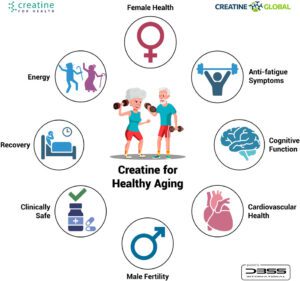
Bonilla, D.A.; Stout, J.R.; Candow, D.G.; Jiménez-García, J.D.; Gómez-Miranda, L.M.; Ortiz-Ortiz, M.; Forbes, S.C.; Ostojic, S.M.; Vargas-Molina, S.; Kreider, R.B.
Frontiers in Physiology 2024, 15, doi:10.3389/fphys.2024.1496544.
“Overall, creatine supplementation in combination with resistance training serves as a safe and effective approach to counteract the progression of sarcopenia (Figure 1). It is clear that creatine monohydrate supplementation—regardless of creatine loading, maintenance dosage, or frequency of ingestion—during a resistance training program increases lean tissue mass and strength compared to a placebo and resistance training alone in older adults (Forbes et al., 2021b). We advocate for the prompt implementation of public health initiatives that promote the inclusion of creatine-rich foods in human nutrition (www.creatine.global) and invite practitioners to visit www.creatineforhealth.com, an initiative that brings together creatine researchers worldwide to accelerate awareness about the role of creatine supplementation for health and in clinical diseases.”